

Measure E Could Reduce Redwood City's Affordable Housing Supply
October 28, 2026 · Michael Arruza Cruz, Redwood City resident
You've probably seen the flyers and posters for Measure E around downtown Redwood City recently, urging you to vote yes on E to make Redwood City more affordable. Proponents have argued that its rent control provisions, if passed, would provide needed rental relief for tenants in older units, broaden tenant protections, and give much needed stability to rent burdened residents.
However, the actual story has proven to be more complicated. Shortly after the measure collected enough signatures to qualify for the ballot, the city voted to formally oppose the measure in a 6-0 vote. And various non-profit organizations running affordable housing projects in the city, such as Midpen and Saint Francis, have publicly opposed the measure as well. It's striking that organizations dedicated to providing affordable housing have raised their concerns so publicly, but their concerns are well founded. Measure E was written with the goal of providing that same stability enjoyed by affordable housing tenants to all Redwood City residents, but goals and outcomes are not always the same thing.
Many well intentioned policies, if not carefully designed, can backfire. Measure E is unfortunately an example of one such policy: it differs from similar rent control laws passed in other cities in ways that could spell disaster for affordable housing providers and negatively impact the quality and sustainability of below market rate units in Redwood City. If passed, it could put the city's affordable housing stock at risk and cause us to backslide on our housing goals.
How Affordable Housing Works
When I talk about affordable housing, I am specifically referring to deed restricted affordable housing that targets low income tenants. These units are legally required to offer below market rent to tenants who qualify under strict income guidelines. The exact rents and income thresholds are set based off of median incomes in the area where the units are built, with the goal of balancing the need to provide deeply affordable units to tenants with the need to ensure that the development and maintenance of the units are sustainable in the long term. Many affordable housing developments achieve this by offering a mix of units targeting different incomes with varying levels of subsidy.
Redwood City publishes its current affordable unit income thresholds and allowable rents here. Using a 1 bedroom apartment as an illustrative example, the current maximum allowable rents are:
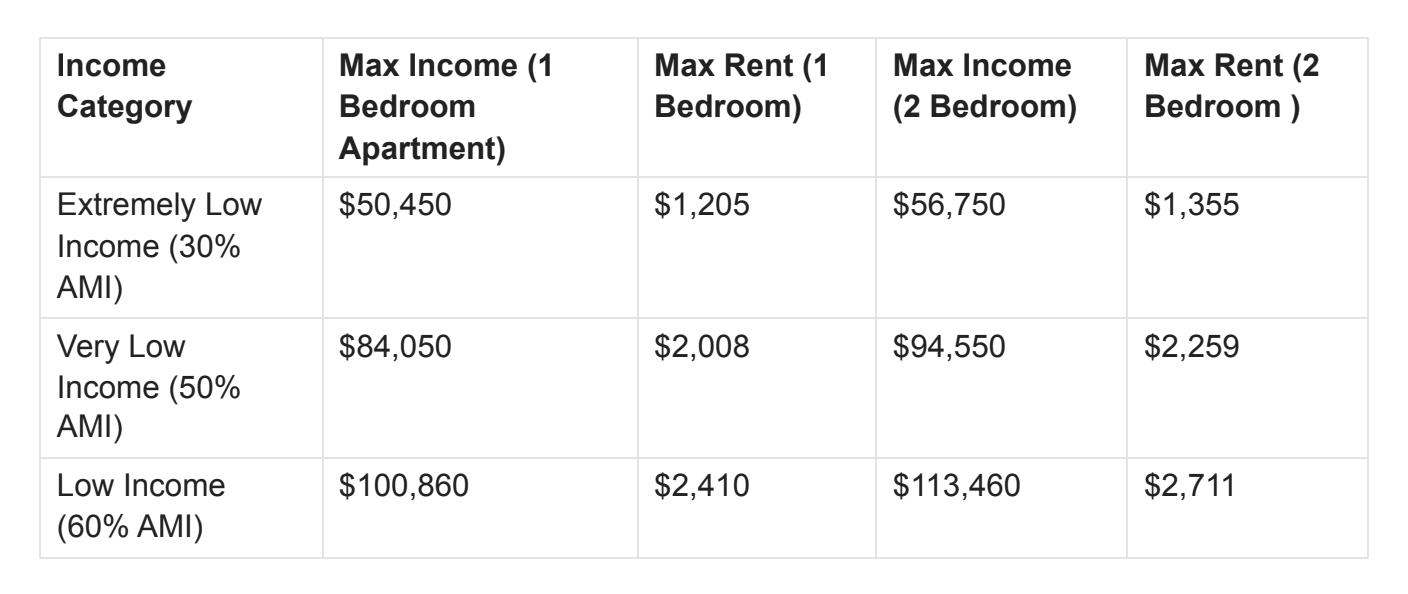
It's worth comparing these rents against a comparable market rate 1 Bedroom Apartment; the city's published figures estimate the average one bedroom apartment rents for $2,843. Affordable housing units represent a substantial discount to comparable market rate units, especially for very low and extremely low income tenants.
Redwood City is lucky to have multiple affordable housing providers running units in the city across the income range. Unlike many other cities that prefer to keep their affordable housing out of sight and out of mind, Redwood City has affordable units in central locations downtown, near services, transit and employment. Midpen's City Center Plaza, for example, offers units targeting the Low and Very Low income thresholds right in the middle of downtown, blocks away from the Caltrain station.
Affordable Housing providers also go beyond simply providing lower rent, and often provide services such as onsite after school tutoring, vocational training, and health screenings. But perhaps the biggest benefit to be gained from moving into an affordable unit is the stability that it offers: maximum rents can only rise at the same rate as area income is rising, allowing for longer term tenancies and a measure of financial stability for low income tenants that often have a hard time finding it elsewhere.
Most affordable housing units are run by mission driven non-profit organizations that are focused primarily on providing housing and the opportunity to live near employment opportunities to low income tenants who would often otherwise lack the ability to afford to live in the bay area.
How Measure E Impacts Affordable Housing in the City
Let's first walk through how the measure would work if passed. The measure introduces rent control to all buildings built before 1995, capping allowable rent increases at 60% of inflation or 5%, whichever is lower. The measure only applies to older buildings due to state law (Costa Hawkins Rental Housing Act) disallowing cities from regulating rent on newer buildings; the measure notably includes a clause stating that should Costa Hawkins ever be repealed, the measure would automatically expand to all buildings older than ten years.
Despite being the most well known aspect of Measure E, rent control is only a small part of the proposed ordinance. The full ordinance is 45 pages long and includes an expansive set of laws covering tenant protections, relocation, right of return, etc. If passed, it would completely replace the city's Tenant Protection Ordinance that went into effect this year. Notably, the measure includes no way for the city to amend any of the language it contains. If passed, it would not only rewrite large swaths of the city's tenant and rental laws, it would also render them impossible to change unless the city places another measure on the ballot in a following election.
Most rent control laws contain language explicitly exempting deed restricted affordable housing units from rent control provisions. Redwood City's own Tenant Protection Ordinance also currently exempts deed restricted affordable housing from many of its provisions. This is an acknowledgement of the fact that affordable housing providers already offer significantly below market rent, and the majority are run by non-profits operating on very tight margins. They often rely on complex funding arrangements combining federal assistance via the Low-Income Housing Tax Credit, state grants, donations, and debt. The reduced rent that is charged helps cover maintenance and tenant services, as well as acting as a cross subsidy; many buildings have units across different income thresholds, with higher rent units helping cover the cost and deeper subsidies for lower income threshold units. It is a complex and at times fragile setup, to say the least.
Measure E does not include any language exempting deed restricted affordable housing from its rent control provisions. Any building built before 1995, regardless of its unit composition or depth of subsidy, must comply with the same rent cap as market rate rentals. But the cost of maintaining the units, providing services, and operational overhead all generally increase by the rate of inflation or more. Market Rate landlords have some ways of absorbing these costs: they can charge higher initial rents on units that are recently vacated, there is natural turnover as tenants move, and the yearly depreciation of rent starts from a higher baseline.[1] Affordable housing providers do not have the same capacity. The rents already start significantly below market; the discount is being applied on an already low starting point. Tenancies in deed restricted affordable housing tend also to be longer than that of market rate units; the stability they offer ends up being a double edged sword, as longer tenancies start to cost them significantly more over time. Affordable housing units pick their unit mix carefully to ensure the long term viability of the project, and those projections rely on being able to update rents as wages grow over time. Those rent increases are also vital to ensuring that the cross subsidy wherein higher income threshold units help subsidize lower income units with deeper rent discounts remains sustainable. Measure E breaks those assumptions, as the strict rent caps mean revenue can't scale at the same rate as wages and costs increase year over year.[2]
The city commissioned a report that modeled the financial impact on a representative affordable housing development built before 1995. The full report dives into more detail, but the findings are rather dire. The report estimated that as costs rose over time, the modeled affordable housing development would need to start depleting cash reserves in order to continue successfully servicing its debt. First, funds set aside for repairs and maintenance would be depleted until they ran out, potentially resulting in deteriorating unit quality as necessary repairs are deferred or skipped outright. Next, funds set aside for tenant services would be used up, resulting in cut or canceled services. Eventually the building would enter a debt service coverage ratio below 1.0, essentially becoming unable to actually service its debt. Without significant further subsidy from the city or state, the buildings would likely fall into disrepair. Redwood City is not currently in a financial position to provide that subsidy, with a projected deficit in its general fund starting next fiscal year, and a stalled development pipeline limiting the amount of new revenue entering the city's affordable housing fund.
The figures from the report paint the picture best, modeling cash reserves for a low income affordable housing project over time for three scenarios:
Scenario 1: Current baseline, no measure.
Scenario 2: Measure passes, building was built after 1995, not subject to rent control provisions.
Scenario 3: Measure passes, building was built before 1995, subject to rent control provisions.
Figures are taken from the full report:
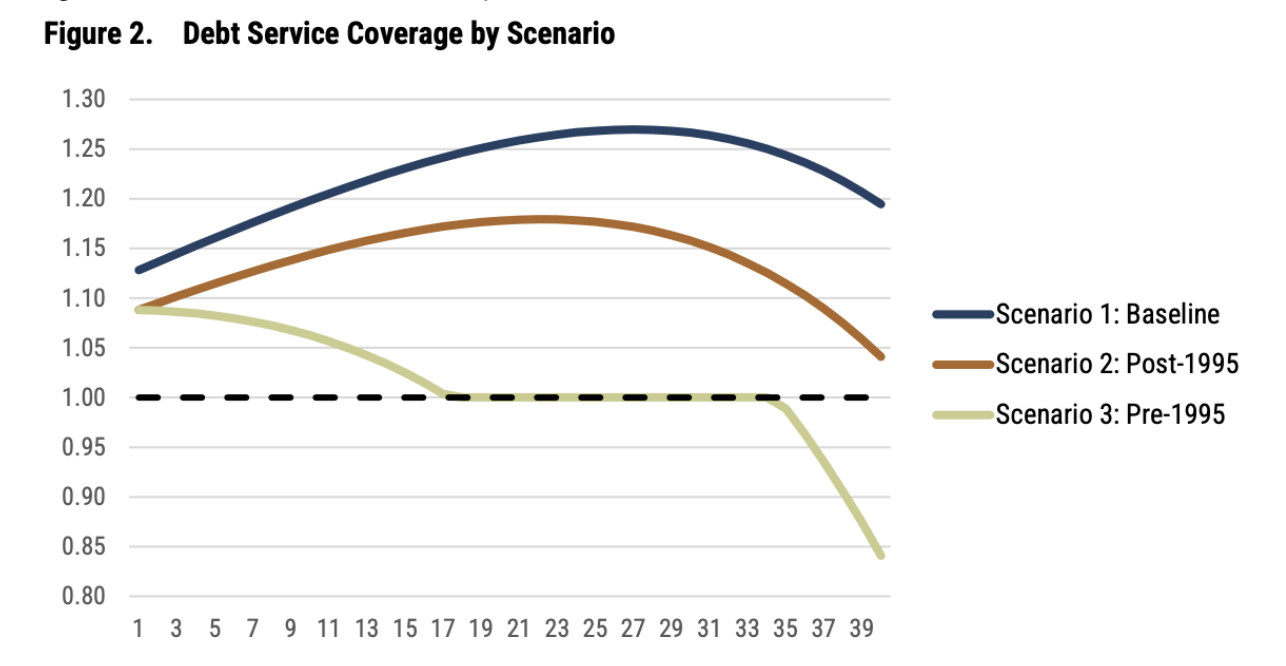
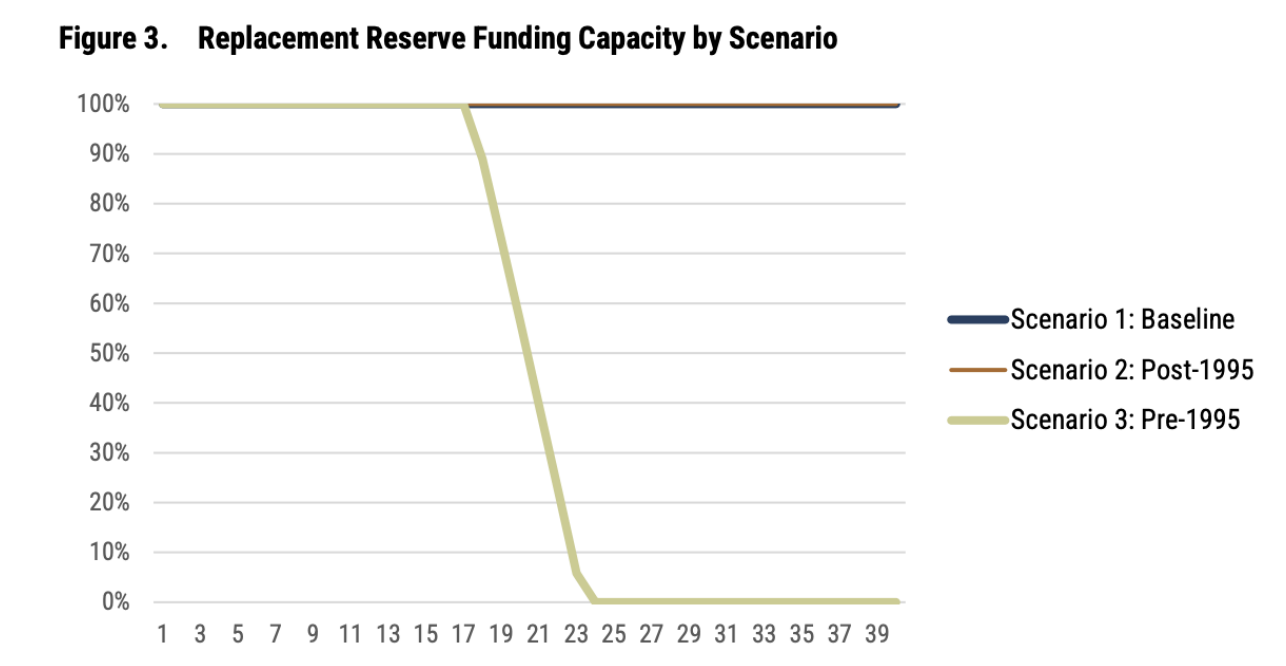
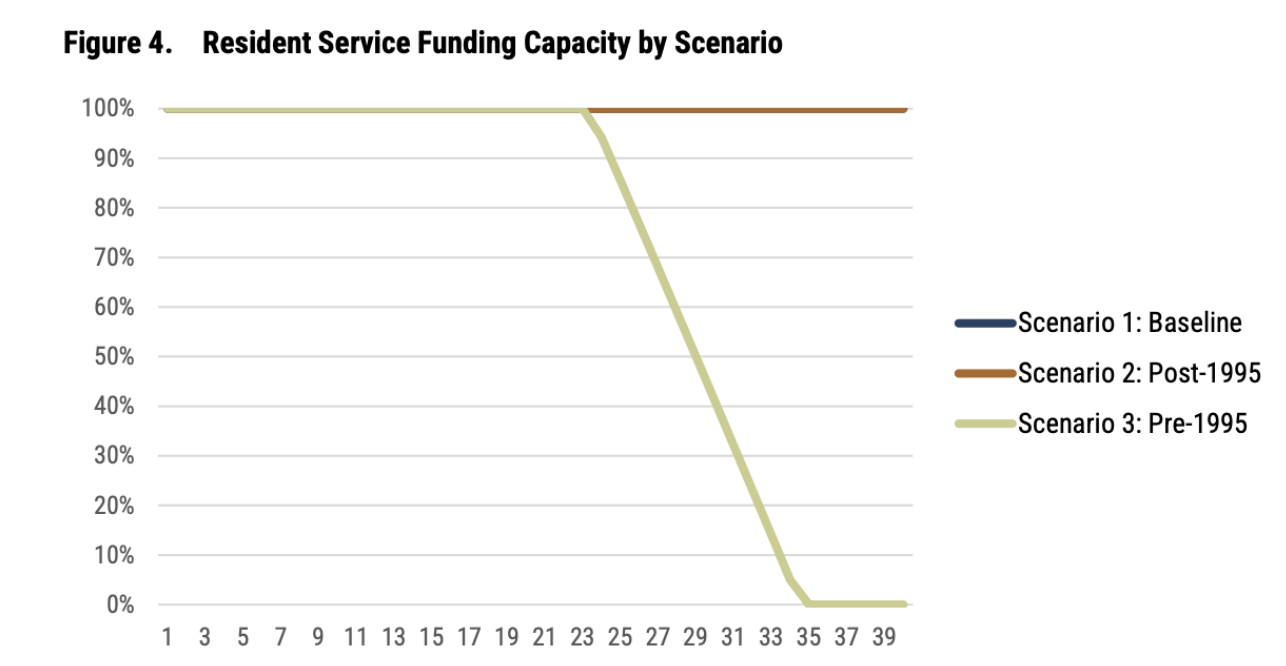
Pre-1995 buildings make up almost half (45%) of all affordable units in the city right now, so it is a significant fraction of our below market rate housing that is being put at risk by this measure.
Several non-profits in Redwood City, such as Midpen and Saint Francis, have already come out against the measure publicly. Notably, even progressive organizations like the Housing Leadership Council that represent affordable housing providers have not taken a position yet and have raised concerns in public comment to city council over the impact it could have. The risks are very real and causing widespread alarm among existing affordable housing developers and providers in the city.
These risks are not easy to mitigate. The city has no means through which it can amend the measure short of placing another measure on the ballot in 2027 and spending resources campaigning for any changes, no matter how small. Some measure proponents have argued that the city can exempt affordable housing units from certain fees in order to help alleviate the pressure. This would do virtually nothing, because the core issue is not the fees the units will be charged, it is that they could not adapt their rents to rising costs and changes to income thresholds in the bay area. The entire financing model breaks, and fee relief wouldn't come close to bridging the gap.
A Personal Note
Despite what I'm sure many might assume given my opposition, I do not have any financial incentive to oppose the rent control measure. I don't own any property, am not a landlord, and do not work in the real estate industry. In fact, I rent a home built before 1995; if this bill were to pass, my unit would be subject to rent control. Measure E, as currently designed, would create an unintuitive mix of winners and losers. I would likely benefit, and some low income tenants in market rate housing would receive rent relief. But other tenants living in below market rate affordable housing face service cuts, deteriorating units, and the very real risk of the affordable housing provider being forced to exit the city outright. Such an outcome doesn't strike me as straightforwardly progressive.
What frustrates me the most about the measure is that it didn't need to be this risky. The measure could have exempted affordable units, like many other rent control laws do. It could have included reasonable provisions for amendment by a supermajority of city council without requiring an expensive ballot measure for any change. Its authors could have collaborated with local affordable housing organizations when drafting its ordinance to ensure that its impacts were restricted to market rate housing. Many of the risks were wholly preventable, but the language has now been submitted and can't be changed. If passed, it could cause severe deterioration of the housing units occupied by some of the most vulnerable tenants in the city. Low income affordable housing is a vital part of our housing mix, and too important to put at risk this November. I urge you to vote no on Measure E.
But I also urge us to not lose sight of the fact that we remain in a housing crisis, and remember that even if Measure E is flawed, it's born of a very real frustration from Redwood City residents at the high cost of living and extortionate rents they pay. I disagree with Faith in Action's drafted measure and don't think it would be good for the city, but I agree with their intent and believe further inaction is equally untenable. I hope this isn't the end of the story; I hope the city recognizes the urgency and frustration that created this measure and continues to build more homes, provide rent relief, and find more opportunities to enable the development of deeply affordable homes in the city.
[1] It's worth noting that even for market rate units, the impact of strict rent controls isn't necessarily more affordable rent for all tenants. Existing tenants who have been renting for a long time benefit from lower rents over time, but newer tenants moving in after a vacancy are often charged higher rents to offset the costs.
[2] Technically, the measure includes a provision allowing for "Upward Adjustments - Right of Reasonable Return for Landlords" that creates a mechanism through which landlords could petition to increase rent by more than the rent cap if doing so is necessary to cover the costs of the unit. The problem is that the measure does not actually include any definition of what constitutes a "reasonable rate of return" anywhere. This is in contrast to other rent control measures, such as the ones passed in Mountain View or Berkeley, which have opted to include actual formulas for how to compute a reasonable rate of return as a function of net operating income. Measure E would turn the current automatic adjustments based on published AMI changes into an annual contested hearing with no guarantee of outcome, and no formally set standard for what constitutes a reasonable rate of return. The language was primarily included because a prior 1976 court ruling (Birkenfeld v. City of Berkeley) requires all new rent control measures to allow for fair return or risk their legality being challenged; it was not necessarily included to be widely used.